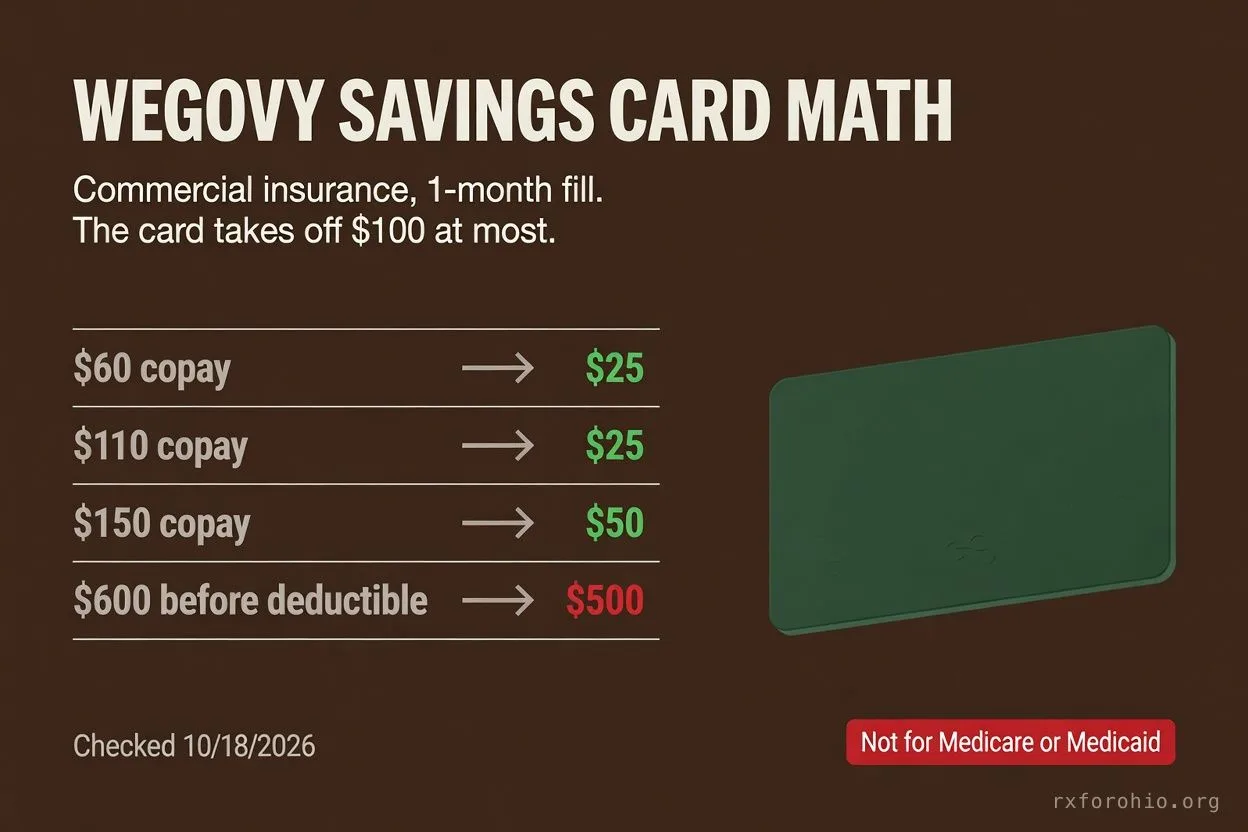
The Wegovy savings card lets you pay as little as $25 for a fill your commercial health plan already covers (checked 10/18/2026). It takes off no more than $100 per 1-month fill, so it does the most good when your copay is already fairly low.
It isn't a discount for everyone. Anyone with Medicare, Medicaid, VA, DoD or TRICARE drug coverage is shut out. You also can't stack the card on top of Novo Nordisk's cash price.
Below: what the caps mean in dollars, who the fine print excludes, and when paying cash is the better deal.
How much does the Wegovy savings card take off?
Novo calls it the Wegovy Savings Offer. Its terms and conditions set a $25 floor and a cap on what the card pays for each fill.
A "month" has a fixed meaning here. Novo defines it as one box of 4 pens, a 28-day supply, or one bottle of 30 tablets.
The cap grows with the fill: $200 off a 2-month fill and $300 off a 3-month fill. Buying three boxes at once doesn't unlock extra savings. It's still $100 per box.
The card works on every pen strength, from 0.25 mg up to the 7.2 mg HD pen. It also covers all four pill strengths: 1.5, 4, 9 and 25 mg.
What will you actually pay with the card?
You pay the larger of two numbers: $25, or your plan's charge minus $100. The card fills the gap between them, up to its cap.
The last row is where people get surprised. Some plans make you pay the full negotiated price until you meet your deductible. When the bill is $600, a $100 discount doesn't change much.
Your plan sets that bill, not Novo. NovoCare's pricing page puts it plainly: your insurance will set the cost for your medication
. The card is a discount applied to that amount.
Who qualifies for the Wegovy savings card?
You need commercial insurance that covers Wegovy, plus a valid prescription with a prescriber ID number.
The prescription has to match the label. Novo's terms say Patients may only participate in this program if they have been prescribed Wegovy® for an FDA-approved indication within Wegovy®’s labeling.
The FDA label (revised 06/2026) lists these uses:
- Pen and pill: lowering the risk of heart attack, stroke and cardiovascular death in adults with established cardiovascular disease and obesity or overweight.
- Pen and pill: long-term weight reduction in adults with obesity, or with overweight plus at least one weight-related condition. The pen is also approved for children 12 and older with obesity.
- Pen only: a liver disease called MASH, in adults with moderate to advanced scarring but no cirrhosis.
A few more rules apply. The card is valid in the US and its territories, and it's limited to 1 offer per person
.
Novo's enrollment page lets a parent or caregiver sign up a teen aged 12 to 17. The adult on the account must be 18 or older.
What does the fine print exclude?
Most of the exclusions sit in a few dense paragraphs. Here they are in plain terms.
Government drug coverage. Patient is not eligible if he/she is enrolled in any federal or state health care program with prescription drug coverage
, the terms say. Medicaid, Medicare, VA, DoD and TRICARE are the examples Novo names.
Two plans at once. The enrollment page adds: Individuals with both commercial and government-funded plans ARE considered patients with government insurance.
A retiree with an employer plan plus Medicare Part D can't use the card.
Plans that aren't "government" here. Novo carves out three kinds of plans: the Federal Employees Health Benefits Program, Affordable Care Act marketplace plans, and state employee plans. People on those plans can still enroll.
Accumulator and maximizer plans. An accumulator plan takes the card's money but doesn't count it toward your deductible. A maximizer plan sets your copay based on how much the card can pay. On either kind of plan, Novo says you will not be eligible for and agree not to use this savings program
.
Alternate funding programs. Novo's terms describe these as plans that may limit or withhold coverage unless you use its self-pay offer. If your plan requires that as a condition of coverage, the card is ruled out.
Stacking. The card cannot be combined with any other coupon, self-pay discount, certificate, voucher, or similar offer
. A discount card doesn't count as insurance either.
Past fills. Anything filled before you enrolled can't be paid back.
Massachusetts. The terms say the offer there depends on state law in effect when you pay.
Does the card help if your plan doesn't cover Wegovy?
Not with the $25 price. That part only works on a fill your plan covers.
But the same card unlocks Novo's cash price. Novo's savings page says the offer can be used to save without insurance or with insurance
. Its pharmacist instructions run rejected and self-pay claims through the same card numbers.
So if your plan rejects the claim, the pharmacy can still run the card and charge you the lower self-pay price.
Cash has a cost of its own. The self-pay terms say you will not apply those costs toward any deductible or true out‑of‑pocket requirements
.
Copay-card dollars are treated differently. Novo says card savings are intended to be credited toward patient out-of-pocket obligations and maximums, including applicable copayments, coinsurance, and deductibles
. Whether that happens is up to your plan, which is why accumulator plans are barred.
When does paying cash beat the Wegovy savings card?
Compare your plan's charge minus $100 with the cash price. For the standard pen, the card wins whenever your plan charges less than $449 a box. That's our arithmetic: $349 plus the $100 cap.
The same math gives $499 for the 7.2 mg HD pen and $249 for the 1.5 mg pill (checked 10/18/2026).
Two things can tip the choice the other way. Novo intends card-assisted fills to count toward your deductible, and its terms say cash fills can't. A $500 bill that moves you closer to your deductible may beat $349 that doesn't.
The second is the $199 new-patient price on the 0.25 mg and 0.5 mg pens. It covers your first two fills if filled by 12/31/2026. Novo counts you as new only if you have not redeemed a savings offer for Wegovy® injection in the past 365 days
. Using the copay card on the pen counts as redeeming one.
When does the Wegovy savings card expire?
Novo's terms don't print an end date for the copay card (checked 10/18/2026). Instead, Novo and its program manager reserve the right to rescind, revoke, or amend this offer without notice at any time
.
The terms also say you must meet the requirements every time you use the card. If you change jobs, switch plans or join Medicare, check again before your next fill.
The one firm date is the $199 intro price, which needs to be filled by 12/31/2026. For the full cash price list, see our Wegovy price check.
How do you get and use the card?
Sign up on the NovoCare savings page, or text SAVE to 83757. Bring the card details to the pharmacy with your prescription.
The pharmacy bills your plan first, then sends the rest to the card as a second payer. You pay what's left.
If you use a mail-order pharmacy that can't process the card, you can mail Novo a reimbursement form within 180 days of the fill. The terms say to allow 6 to 8 weeks for payment. Questions go to 1-888-793-1218.
What if you're on Medicare?
The card is off the table. Some Part D enrollees can get Wegovy for a $50 copay through the Medicare GLP-1 Bridge, which CMS runs from 07/01/2026 to 12/31/2027. The CMS prescriber sheet lists the Wegovy pen and pill among the covered drugs.
Our Medicare Wegovy coverage guide covers who qualifies. If you're comparing brands, our Zepbound savings card page does the same math for Lilly's card.
Where these numbers come from
On 10/18/2026, the Rx For Ohio desk read Novo Nordisk's savings and self-pay terms and the NovoCare pricing and enrollment pages. We also read the FDA label and both CMS Bridge sources. The tables above show the source for each price and the date we read it. If the terms change, we'll date the update here and in the price change log.